
Trade Mark Revocation - a quick guide
What is Trade Mark Revocation?
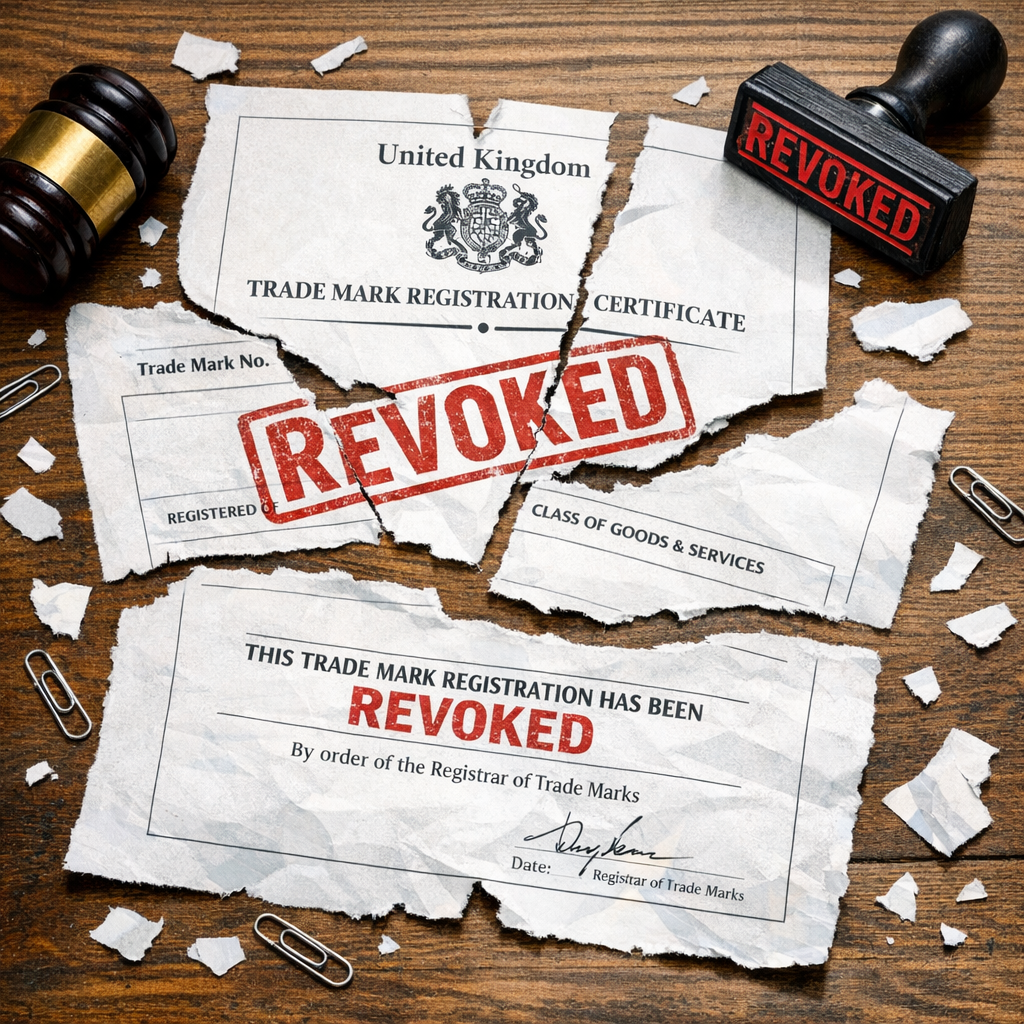
Trade mark revocation is the legal process by which a registered trade mark is removed from the register, either in whole or in part. Unlike invalidity proceedings, which challenge whether a mark should ever have been registered in the first place, revocation deals with circumstances arising after registration that justify the loss of protection.
Grounds for Revocation
There are four principal grounds for revocation under UK law:
1. Non-Use for Five Years
This is by far the most common ground for revocation. A trade mark may be revoked if, within a continuous period of five years following the date of completion of registration, it has not been put to genuine use in the UK in relation to the goods or services for which it is registered, and there are no proper reasons for non-use.
2. Suspension of Use for Five Years
A trade mark may also be revoked if genuine use has been suspended for an uninterrupted period of five years, again without proper reasons.
3. Becoming a Common Name (Genericism)
If, in consequence of acts or inactivity of the proprietor, the trade mark has become the common name in the trade for a product or service for which it is registered, it can be revoked. Famous historical examples include marks such as "Escalator" and "Aspirin" (in some jurisdictions).
4. Misleading Use
A trade mark may be revoked if, in consequence of the use made of it by the proprietor (or with their consent), it is liable to mislead the public, particularly as to the nature, quality, or geographical origin of the goods or services.
Who Can Apply for Revocation?
Any person may apply for revocation of a registered trade mark. There is no requirement to demonstrate a legitimate interest or commercial justification. In practice, applications are typically brought by:
Competitors seeking to clear the register
Businesses facing opposition or infringement claims who wish to attack the registration relied upon
Parties seeking to register similar marks blocked by the registration in question
The Revocation Process
Step 1: Pre-Action Considerations
Before filing, careful investigation should be undertaken to assess the strength of the case. This may include market research, evidence gathering, and consideration of any commercial relationship with the proprietor. Pre-action correspondence is sometimes appropriate, particularly where a negotiated surrender or partial cancellation may be achievable.
Step 2: Filing the Application
Applications are made to the UK Intellectual Property Office (UKIPO). A fee is payable, and the application must specify the grounds relied upon and the goods or services targeted.
Step 3: Defence and Evidence
The registered proprietor will be notified and given the opportunity to file a defence. In non-use revocation actions, the burden of proving use lies on the proprietor, who must file evidence (usually by way of witness statement with exhibits) demonstrating genuine use during the relevant five-year period, or proper reasons for non-use.
Step 4: Evidence Rounds and Submissions
The applicant then has an opportunity to file evidence in reply, followed by submissions from both parties. The UKIPO may also direct further rounds of evidence if appropriate.
Step 5: Hearing or Decision on the Papers
Either party may request an oral hearing, or the matter can be decided on the papers. The Hearing Officer will issue a written decision setting out their findings.
Step 6: Outcome
If revocation is granted, the trade mark is removed from the register. The effective date of revocation is generally the date of the application for revocation, although it may be earlier if the applicant requests and proves an earlier date of cessation of use. Partial revocation is also possible, where the registration is cut down to those goods or services for which genuine use can be proven.
Costs
Costs are usually awarded to the successful party in accordance with the UKIPO's published scale, which provides for contributions towards costs rather than full recovery. Inter partes proceedings before the UKIPO are typically far less costly than litigation in the courts.
Practical Tips for Brand Owners
To protect against revocation, trade mark proprietors should:
Maintain clear records of use, including dated samples of marketing materials, invoices, packaging, and sales figures
Audit portfolios regularly to identify marks at risk and consider refiling strategies where appropriate (bearing in mind the case law on bad faith refilings)
Use marks as registered, or in a form that does not alter their distinctive character
Ensure use covers the full specification, or be prepared for partial revocation
Take action against generic use by third parties to avoid the mark becoming a common name
Conclusion
Trade mark revocation is a powerful tool. Understanding the grounds, the evidential requirements, and the procedure is essential for any business with a trade mark portfolio. If you would like advice on bringing or defending a revocation action, or on protecting your trade mark portfolio against the risk of revocation, get in touch.