
The Madrid Protocol – What is it?
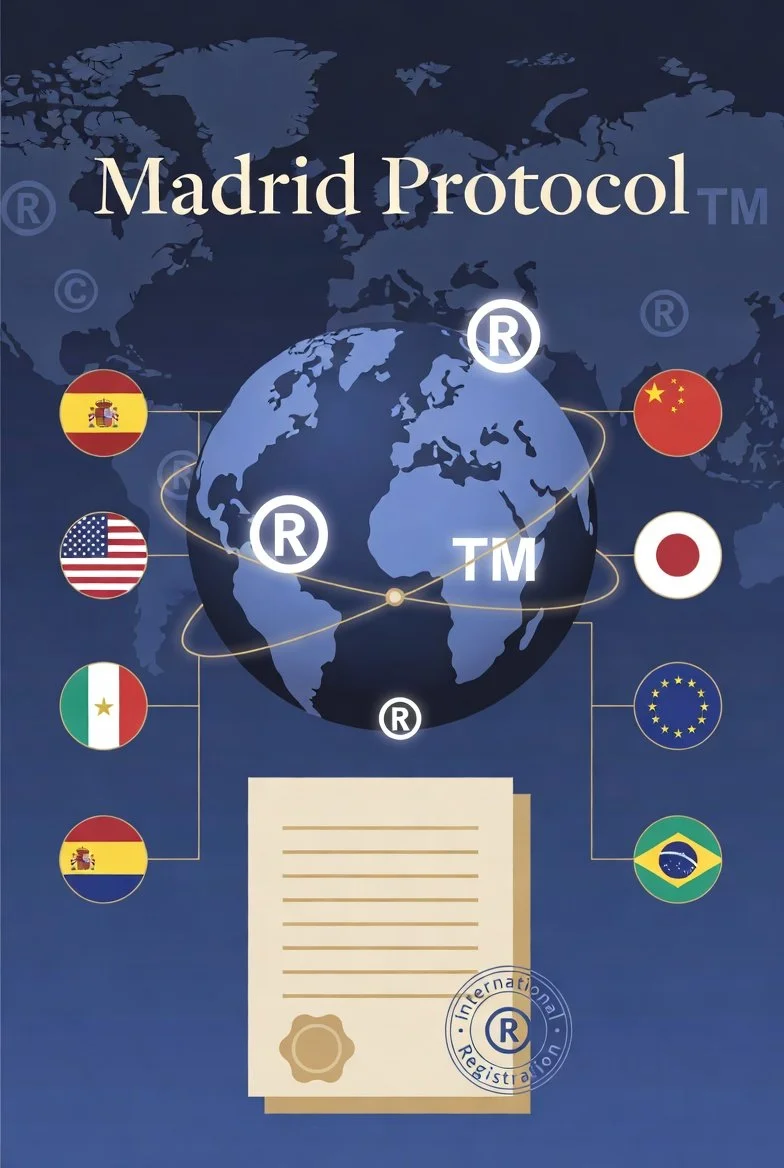
The Madrid Protocol, formally known as the Protocol Relating to the Madrid Agreement Concerning the International Registration of Marks, is an international treaty administered by the World Intellectual Property Organization (WIPO) in Geneva. Adopted in 1989 and entering into force in 1996, the Protocol forms part of the broader Madrid System for the international registration of marks.
The purpose of the Madrid Protocol is to streamline and simplify the registration of trade marks internationally. As of 2026, the Madrid System has 116 members, covering more than 80% of world trade. Notable members include the United Kingdom, the European Union, the United States, China, Japan, Australia, and most major trading nations.
How Does the Madrid Protocol Work?
The Madrid Protocol provides a centralised filing system that allows trade mark owners to seek protection in multiple jurisdictions through a single application. The process operates as follows:
1. Basic Application or Registration
Before filing an international application, the applicant must have either a pending trade mark application or an existing registration in their "home" jurisdiction—known as the "basic mark." For UK applicants, this means filing or holding a registration with the UK Intellectual Property Office (UKIPO).
2. International Application via the Office of Origin
The international application is submitted through the UKIPO (acting as the "Office of Origin"), which certifies that the details match the basic mark before forwarding the application to WIPO. Applicants must designate the member countries in which protection is sought.
3. WIPO Examination
WIPO conducts a formal examination of the application, checking for compliance with procedural requirements, classification of goods and services under the Nice Classification system, and payment of fees. If satisfied, WIPO records the mark on the International Register and publishes it in the WIPO Gazette of International Marks.
4. Examination by Designated Contracting Parties
Each designated country then examines the application according to its own national laws. Each office has either 12 or 18 months (depending on the jurisdiction) to issue a refusal. If no refusal is issued within this period, protection is automatically granted in that territory.
5. International Registration
Once granted, the international registration has effect in each designated country as if the mark had been registered nationally. The initial registration lasts for 10 years and can be renewed indefinitely in 10-year increments.
Key Benefits of the Madrid Protocol
1. Cost Efficiency
Filing a single international application can be significantly more economical than filing separate national applications in each country of interest. Applicants save on translation costs, local agent fees, and multiple filing fees, particularly when seeking protection in numerous jurisdictions.
2. Streamlined Administration
The Madrid System provides a single point of contact for managing an international portfolio. Renewals, changes of ownership, address updates, and licensing recordals can all be managed centrally through WIPO, rather than requiring separate procedures in each country.
3. Simplified Process
Applicants file one application, in one language (English, French, or Spanish), pay one set of fees in one currency (Swiss francs), and obtain protection across multiple territories. This significantly reduces administrative complexity.
4. Subsequent Designations
Once an international registration is in place, the holder can extend protection to additional member countries through "subsequent designations," allowing brand protection to grow alongside business expansion.
Potential Drawbacks and Considerations
While the Madrid Protocol offers significant advantages, there are important considerations:
5. Central Attack Vulnerability
For the first five years, the international registration is dependent on the basic mark. If the basic application or registration is cancelled, refused, or withdrawn during this period (whether through opposition, non-use, or invalidity), the international registration falls with it—a phenomenon known as "central attack." However, the holder may convert the international registration into national applications in each designated country, preserving the original filing date (this process is known as "transformation").
6. National Law Variations
Each designated country examines the application under its own laws. A mark acceptable in the UK may face refusal elsewhere due to absolute grounds, relative grounds, or local linguistic considerations.
7. Limitations on Amendments
The international registration is tied to the scope of goods and services in the basic mark. Applicants cannot broaden the specification beyond what is covered in the home application.
8. Not Universal
Despite its broad reach, certain commercially significant jurisdictions—such as several Middle Eastern and South American countries—remain outside the system, requiring separate national filings.
Strategic Considerations for UK Businesses
When formulating an international filing strategy, UK businesses should consider:
Target markets: Where does the business currently operate, and where does it plan to expand?
Manufacturing and distribution locations: Protection should extend to jurisdictions where goods are produced and traded.
Risk of infringement: Markets known for counterfeiting may warrant proactive registration.
Budget considerations: The Madrid System offers significant savings, but careful country selection is essential.
Strength of the basic mark: Given the central attack risk, ensuring a robust UK application is vital before extending internationally.
Conclusion
The Madrid Protocol is an effective tool for international trade mark protection, offering UK businesses a cost-effective route to securing global brand rights. However, navigating the system requires careful strategic planning, and awareness of potential pitfalls. Whether you are filing your first international application or managing an established global portfolio, we can assist you. We have years of experience filing, prosecuting and managing trade mark applications and portfolios for our clients. Get in touch to see how we can help you.