
Passing Off - A Brief Guide
Passing off is a common law tort that prevents one trader from misrepresenting their goods or services as those of another. In simple terms, it stops a competitor from "riding on the coat-tails" of your business reputation by deceiving customers into believing their products or services are connected with yours.
Unlike trade mark infringement, which requires a registered right, passing off protects unregistered rights. This makes it particularly valuable for businesses that have built up a reputation in a brand, logo, packaging style, or trading name without registering it as a trade mark.
Origins
The tort of passing off has its roots in the 19th century and has been refined over more than a century of case law. The modern test was established by the House of Lords in Reckitt & Colman Products Ltd v Borden Inc [1990] 1 WLR 491 (known as the "Jif Lemon" case), which set out what are now as the "Classical Trinity".
The Classical Trinity: The Three Elements of Passing Off
To succeed in a passing off claim, a claimant must prove three elements:
Goodwill
The claimant must demonstrate that they own goodwill or reputation attached to their goods or services in the mind of the purchasing public. Goodwill was famously described by Lord Macnaghten in IRC v Muller & Co's Margarine Ltd [1901] AC 217 as "the attractive force which brings in custom."
Goodwill is typically associated with:
· Business names and trading styles
· Product names and brands
· Distinctive packaging or "get-up"
· Logos and visual identity
· Slogans and marketing taglines
· Domain names and online presence
Importantly, goodwill must exist in the UK jurisdiction at the relevant time. Mere reputation without customers in the UK is generally insufficient, as confirmed in Starbucks (HK) Ltd v British Sky Broadcasting Group plc.
Misrepresentation
The defendant must have made a misrepresentation (whether intentional or not) to the public that leads, or is likely to lead, them to believe that the defendant's goods or services are those of the claimant, or are connected with the claimant.
The misrepresentation does not need to be deliberate – innocent misrepresentation can still found a claim. What matters is the effect on the relevant public, namely whether ordinary, reasonable consumers are likely to be confused or deceived.
Damage
The claimant must demonstrate that they have suffered, or are likely to suffer, damage as a result of the misrepresentation. Damage can take various forms, including:
· Lost sales and diverted custom
· Damage to reputation (particularly if the defendant's goods are inferior)
· Loss of licensing opportunities
· "Erosion" or dilution of the distinctiveness of the claimant's brand
Common Examples of Passing Off
Passing off claims arise in a wide variety of commercial situations. Common scenarios include:
· Lookalike products: A competitor adopts packaging, colours, or shape similar to a well-known product (as in the Jif Lemon case itself).
· Confusingly similar trading names: A new business adopts a name very close to an established competitor in the same sector.
· Domain name disputes: A third party registers a domain name incorporating a well-known brand.
· Celebrity and personality rights: Unauthorised use of a celebrity's image to suggest endorsement (see Irvine v Talksport Ltd [2002] EWHC 367).
· False endorsement and reverse passing off: Where a trader passes off the claimant's goods as their own.
Passing Off vs Trade Mark Infringement
While both protect brand identity, the two causes of action differ significantly:
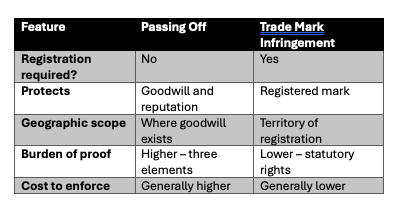
In practice, claimants often plead both causes of action in parallel where they hold a registered trade mark.
Remedies Available
A successful passing off claim can result in a range of remedies, including:
· Injunctions (interim and final) to prevent further passing off
· Damages to compensate for losses suffered
· An account of profits earned by the defendant from the unlawful activity
· Delivery up or destruction of infringing goods and materials
· Declarations confirming the claimant's rights
Practical Tips for Protecting Your Business
To strengthen your position should a passing off dispute arise, we recommend the following steps:
· Document your goodwill: Keep records of marketing spend, sales figures, customer numbers, press coverage, and awards.
· Use distinctive branding consistently: The more distinctive and consistent your branding, the easier it is to demonstrate goodwill.
· Monitor the marketplace: Regularly check for competitors using similar names, packaging, or marketing material.
· Act promptly: Delay can be fatal to a passing off claim, particularly when seeking interim injunctive relief.
· Consider registration where possible: While passing off is a powerful tool, registered trade marks remain easier and cheaper to enforce. Use both in combination wherever feasible.
Conclusion
Passing off remains a useful tool in the intellectual property arsenal. Succeeding in a passing off claim requires careful evidence-gathering and a clear understanding of the Classical Trinity.
If you believe your business may be the victim of passing off, or if you have received a passing off claim, we are here to help.